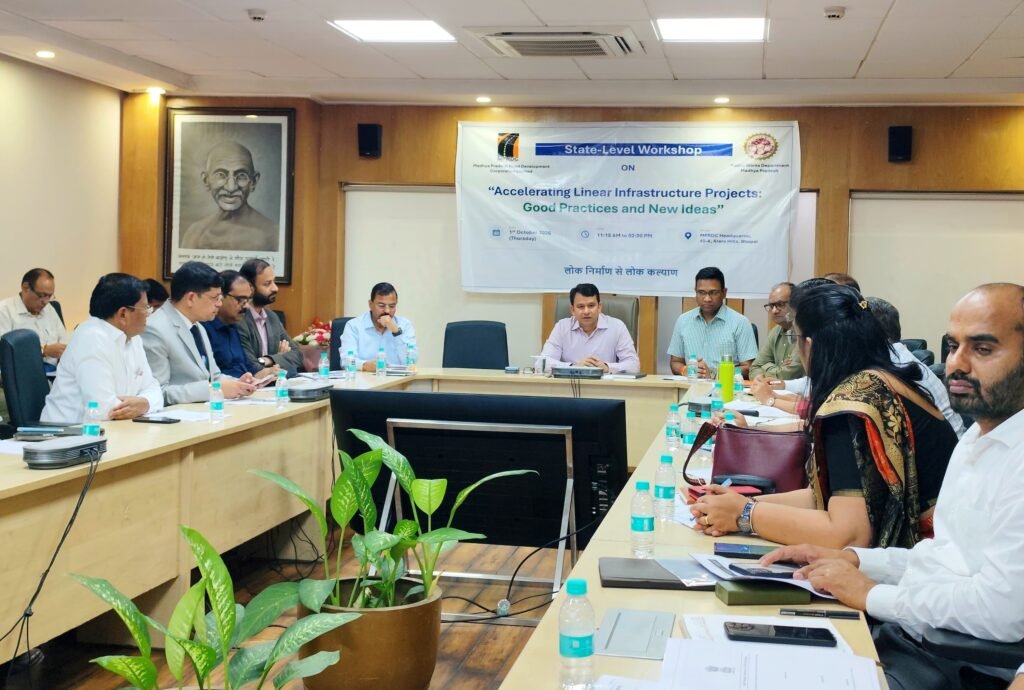
- State-level workshop held regarding preparations for the 6th Chief Secretary Conference under the chairmanship of Prime Minister Narendra Modi.
Bhopal. Inter-departmental coordination among various departments should be made more effective so that necessary approvals for projects are received on time and construction work can be completed within the stipulated time frame. This was stated by MPRDC Managing Director Bharat Yadav during a state-level workshop held at the Bhopal headquarters regarding preparations for the 6th Chief Secretary Conference to be chaired by Prime Minister Narendra Modi.
Held on the theme “Accelerating Linear Infrastructure Projects: Good Practices and New Ideas”, the main objective of this workshop was to identify bottlenecks in the implementation of linear infrastructure projects, their solutions, and to share best practices and innovations across various departments.
In his concluding remarks, Managing Director Bharat Yadav emphasized that the preparation of the DPR (Detailed Project Report) should be carried out with utmost seriousness before the project commences, so that project-related permissions and other bottlenecks can be identified at the initial stage itself and their resolution ensured in time. He appealed to all departmental representatives present at the workshop to compulsorily fill out the feedback form, enabling the selection of best practices from the received suggestions to be presented before NITI Aayog.
Presenting the outline, MPRDC Technical Advisor R.K. Mehra stated that in alignment with the goals of Viksit Bharat-2047, information will be submitted to NITI Aayog through feedback forms after studying the difficulties in constructing linear infrastructure projects, reducing delays in mandatory permissions, and analyzing the best practices of various departments, thereby making project implementation smoother and more time-bound.
During the workshop, Additional Principal Chief Conservator of Forests from the Forest Department, H.S. Mohanta, provided detailed insights into the procedures and practical challenges concerning approvals on the Parivesh portal, forest land diversion, eco-sensitive zones, biodiversity areas, sanctuaries, and tiger reserve zones. He also offered practical suggestions for addressing plantation-related challenges. Additionally, detailed deliberations were held on land acquisition, ROW/ROU, wildlife clearances, utility shifting, state-level permissions, construction materials, and other essential approvals.
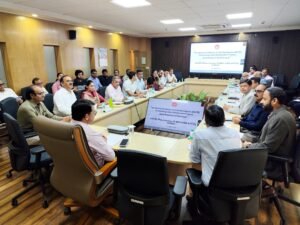
In the workshop, land acquisition and environmental experts of MPRDC delivered a comprehensive presentation to make the land acquisition process simple and effective. Furthermore, presentations and suggestions were also shared by representatives from the Public Works Department, MP Power Transmission Company Limited, PHE, NHAI, NITI Aayog, Indian Railways, IOCL, Revenue Department, Madhya Kshetra Vidyut Vitran Company, Bhopal Development Authority, Madhya Pradesh Rural Road Development Authority, Urban Development Department, Water Resources Department, MP Metro, Madhya Pradesh Pollution Control Board, and Madhya Pradesh Industrial Development Corporation.