
-
The ‘Aath Pahar’ digital wall clock is an innovative experiment linked to mathematical education and Indian knowledge tradition.
-
Inventors and designers Dr. Rajat Kaushik, Manish Kushwaha, and their collaborator achieved a major milestone.
-
Traditional Indian time-knowledge will receive a digital identity through modern learning and technology.
Bhopal. In the changing era of technology, even though clock hands move according to modern times, an innovative digital wall clock is now set to become a new medium for understanding time in the Indian tradition. The digital wall clock, built on the ancient “Aath Pahar” concept of Indian time calculation, has received a design patent from the Patent Office of the Government of India. Receiving official recognition for this unique experiment, which bridges traditional Indian knowledge with modern technology, is regarded as a notable achievement in the field of mathematical and educational innovation.
The design patent for this digital wall clock is registered in the names of Dr. Rajat Kaushik, Assistant Professor at the Regional Institute of Education (RIE), Bhopal, Manish Kushwaha, and their collaborator Vivek Yadav. The Indian Patent Office issued registered design number 494340-001 and the patent certificate on September 8. According to the designers, this registration was completed under Class 10-01 for a ‘DIGITAL WALL CLOCK’.
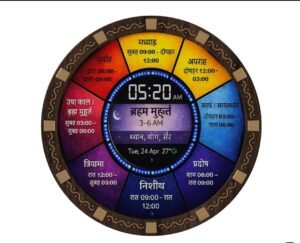
An Effort to Give Modern Form to Indian Time-Knowledge
‘Aath Pahar’ is an ancient and widely accepted concept of traditional Indian time division. Dividing the 24 hours of day and night into distinct pahars to understand time has long been part of the Indian knowledge system. Presenting this very concept as a modern digital clock is the defining feature of this design. Design inventors Dr. Rajat Kaushik and Manish Kushwaha shared that the goal of this innovation is not merely to create a time-telling device, but to make traditional Indian knowledge accessible through modern educational and technical mediums. They believe this clock will help Gen Z youth and students develop a mathematical understanding of time while connecting with the Indian knowledge tradition.

High Potential for Utility in Education
This ‘Aath Pahar’ digital clock design can be immensely useful for understanding the nuances of mathematics, enabling activity-based learning, and discovering new educational resources. It allows students to easily comprehend the relationship between traditional time division, mathematical calculations, and the modern time system. The designers noted that such innovations align directly with the emphasis placed on the Indian knowledge tradition, experiential learning, and innovation under the National Education Policy (NEP) 2020. Furthermore, this patent will encourage teachers and researchers to develop new educational tools grounded in Indian concepts.
Would you like me to summarize this translated article into a shorter press release format or social media post?