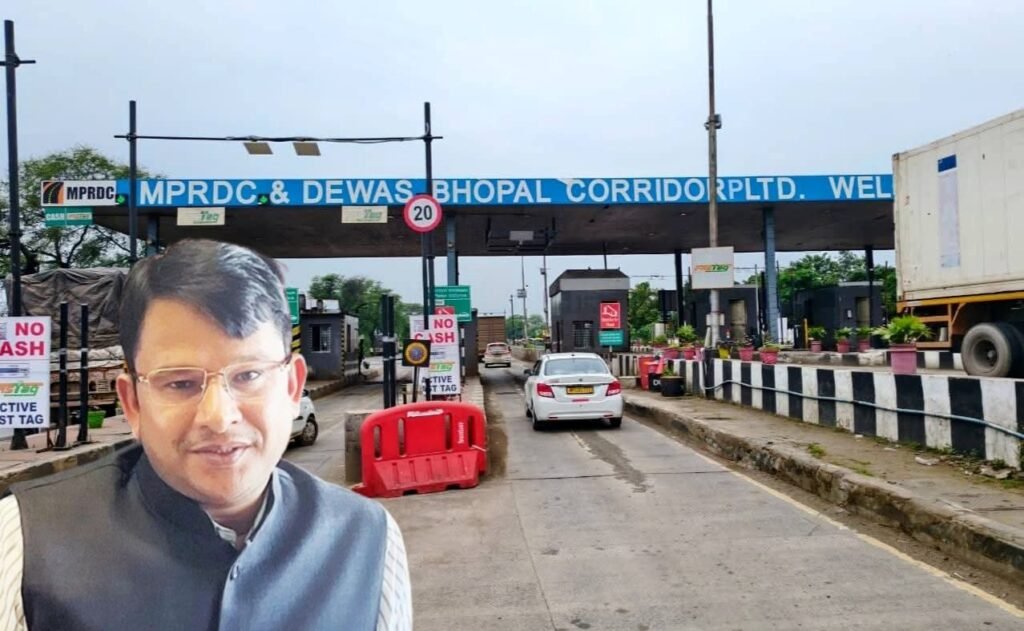
Bhopal. Madhya Pradesh Road Development Corporation (MPRDC) has started pilot testing for Single Lane Free Flow (SLFF) barrier-less tolling on the state’s highway network. With this, Madhya Pradesh has become the first state in the country to implement this technology on state highways. Inspired by highway systems in Germany and other developed countries, MPRDC achieved this milestone under the visionary leadership of Managing Director (MD) Bharat Yadav (IAS). The pilot test of the state’s first ‘barrier-less tolling’ system was successfully launched at the Phanda Toll Plaza on the Bhopal-Dewas route.
Under this system, vehicles do not need to stop or slow down at the toll plaza. Vehicles can cross the toll plaza at speeds up to 100 km/h. Traditional boom barriers and manual toll collection staff are no longer needed in the toll lane, eliminating unnecessary braking, traffic congestion, and wasted time for commuters.
The SLFF lane is equipped with advanced technology, including FASTag/RFID readers, high-resolution ANPR cameras, vehicle detection and classification sensors, lane controllers, and transaction processing systems. As a vehicle passes through, overhead gantry sensors and cameras automatically identify and classify the vehicle at high speeds. The toll amount is then deducted directly from the linked account via FASTag details in a completely contactless and automated process.
If a vehicle lacks sufficient FASTag balance, has an incorrectly registered license plate, or encounters a technical payment failure, an e-notice will be sent to the vehicle owner. The driver will be given a 3-day window to pay the toll amount. If payment is not made within 3 days, legal recovery procedures including penalties will be initiated.
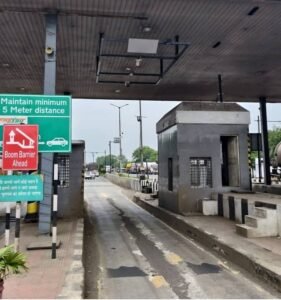
Barrier free toll plaza khajuri bypass Bhopal MP first barrier free toll plaza
Key Benefits of the SLFF System:
Zero Wait Time and Freedom from Boom Barriers: Vehicles pass through directly without stopping, eliminating long queues at toll plazas.
Time and Fuel Savings: Eliminating frequent stopping, idling, and re-accelerating reduces fuel consumption and saves significant travel time.
Transparency and Reduced Operational Costs: Removing manual intervention lowers manpower and operational costs while ensuring full transparency and efficiency in toll collection.
Currently, the pilot test is active in one lane at the Phanda toll plaza. Based on the review and results of this trial, the system is planned for full implementation across all lanes of the three toll plazas on the Bhopal–Dewas route starting January 1, 2027.
While this technology is widely used in Europe and Germany, in India it was previously limited to select National Highways (NHAI) and new expressways, operating at only 6 national toll plazas (such as Choryasi on NH-48, Mundka in Delhi, Gharaunda on NH-44, and Daulatpura, Manoharpur, and Shahjahanpur in Rajasthan). By extending this system to its state highway network, Madhya Pradesh has set a new benchmark for state-level infrastructure innovation.
Strengthening the traffic system by using advanced technology across the state highway network is our priority. The pilot test started at the Phanda toll plaza on the Bhopal-Dewas route is a major step in this direction. Madhya Pradesh has become the first state in the country to implement this system on state highways. With this technology, vehicles will be able to pass at a speed of 100 km/h without stopping, saving time and fuel for the public.
-Bharat Yadav (IAS), Managing Director, MPRDC